
Morrisville City Directory Holdings
The verified starting shelf is the Olivia Raney Local History Library catalog record, not a dedicated Morrisville directory series. It lists Raleigh-area titles and variants from R.L. Polk & Co., Hill Directory Company, Branson, Maloney, Wills-Smith, and other publishers. That regional framing matters. A Morrisville address may be indexed under Raleigh, Wake County, or another nearby municipal label, so the printed city on a cover should not be treated as a hard boundary for a Morrisville family search.
The holdings are reference and noncirculating. They are valuable because they preserve many dated snapshots, not because they supply a complete annual record. The catalog confirms specific runs from 1880 through 2004, with gaps. It also supplies a path to reverse directories, deed microfilm, and property maps when a name does not appear in a normal alphabetical volume.
| Research collection | Verified date range | Holding location | Use route |
|---|---|---|---|
| Raleigh city-directory variants | 1880-2004, noncontinuous | Olivia Raney Local History Library | Reference shelf, confirm the specific year. |
| Wills-Smith Raleigh Criss-Cross | Exact run not located | Olivia Raney catalog and shelves | Address-to-name lead; call for years. |
| Wake deed microfilm and fiche | Catalog examples from 1942 onward | Olivia Raney | Older-record fallback, noncirculating. |
| Wake County Property Maps | About 1958, volumes 1-5 | Olivia Raney | Parcel and lot context at the library. |
Note: A cataloged gap means a missing or unverified volume, not proof that a person left Morrisville or was absent from the community.
Morrisville City Directory Shelf Access
Olivia Raney is at 4016 Carya Drive in Raleigh. The State Library listing gives weekday hours of 10 a.m. to 6 p.m., Saturday hours of 10 a.m. to 2 p.m., and Sunday closure. Its reference desk can help distinguish a year that is not held from a year that was searched with no result. Bring alternate spellings, an approximate date, a street name, and the county. Calling ahead at (919) 250-1196 is sensible when a particular volume or microfilm item matters.
The local-history route is broader than city directories. The same library has Wake deed microfilm or fiche and property-map materials. That makes it possible to compare a printed household clue with a parcel description without pretending that the printed entry proves ownership or current presence. The State Library directory entry for Olivia Raney also identifies the reference-contact path.
The Wake library catalog record shows the publisher and title variants available to a Morrisville historical search.
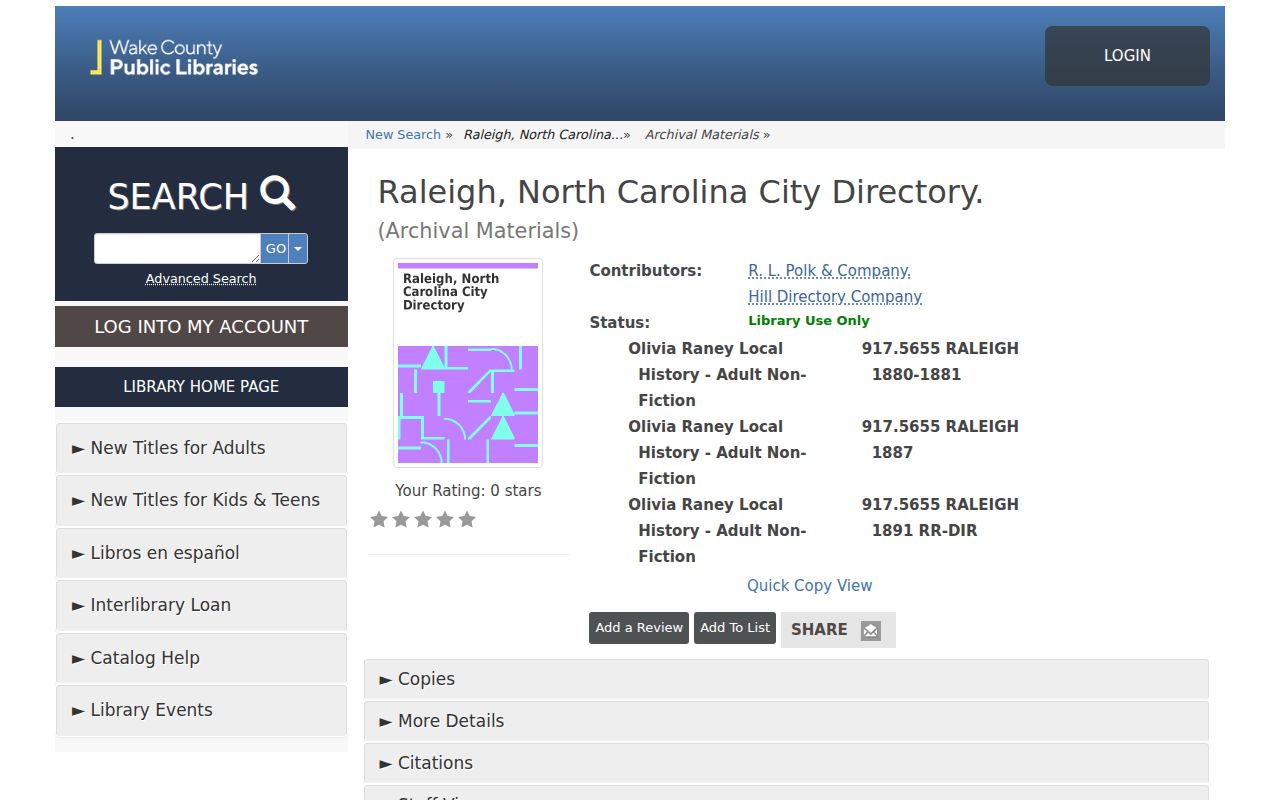
The catalog view is a holdings clue, not a scanned directory page, so the exact name, abbreviation key, and page citation still need to come from the volume itself.
Morrisville City Directory Gaps Matter
The Morrisville city directory collection is especially useful because its gaps are known rather than hidden. Verified entries include 1880-81, 1887, 1891, 1896-97, 1899-1900, several early twentieth-century pairs, 1935-43, 1945-65, 1968-79, and selected later runs through 2004. Those dates are catalog evidence, not an uninterrupted publishing calendar. The library record does not establish a first or last Morrisville-only directory, and it does not support filling absent years with assumptions.
Digitization adds another layer, not a replacement shelf. North Carolina's digital collections entry point is a useful way to locate state material, but the research did not locate a dedicated Morrisville city-directory scan. Use online images as a discovery route, then retain the catalog title, year, page, and original custodian in your notes.
| 1880-1881 and 1887 | Early verified catalog entries for the Raleigh-area directory shelf. |
|---|---|
| 1935-1943 | A documented multi-year sequence, still subject to checking individual holdings. |
| 1945-1965 | Another long cataloged segment, not proof every address appears yearly. |
| 2002 and 2004 | Later cataloged volume entries; the catalog does not establish a Morrisville-only end date. |
A North Carolina digital collections search provides a starting point for scanned state material.
The image documents the digital-collection entrance, while the researched gap remains important: it does not establish a Morrisville directory scan.
Read a Morrisville City Directory
A printed entry is a dated observation. It commonly places a surname and given name with a street address. Depending on the publisher and year, it may also include a spouse or household notation, occupation, business connection, a widow notation, or a telephone number. The Olivia Raney catalog does not expose a scanned Morrisville entry, so none of those fields should be assumed for every volume. Read the specific page and its front-matter key before expanding shorthand.
Preserve the printed form exactly. Initials, punctuation, a street suffix, and a page number can decide whether a later deed, census line, or newspaper notice belongs to the same person. If an entry contains a status symbol, copy it first and interpret it only if the volume's own key defines the symbol.
| Printed name | Copy spelling, initials, and punctuation exactly as they appear. |
|---|---|
| Street line | Record the number and street abbreviation, then compare alternate road names. |
| Household notation | Preserve any spouse, widow, or relationship wording without expanding it. |
| Work or business detail | Use it as a distinguishing clue, not proof of a personal address. |
| Page citation | Keep the title, year, and page so another researcher can check it. |
- Criss-cross directory
- A reverse section arranged by address, used to move from a street number to a printed name.
- Householder index
- An index organized around a household name when a volume includes one; its exact form varies by publisher.
- Abbreviation key
- The publisher's explanation of shorthand, usually near the front of the exact volume being used.
Morrisville City Directory Criss-Cross
The cataloged title Wills-Smith Raleigh Criss-Cross Directory is the strongest verified reverse-directory lead for a Morrisville address. Its purpose is different from an alphabetical city directory. Begin with the street name and number, then return to the normal name section for the spelling and any household or business context. The catalog does not state a complete year list for this title, so a reference-desk request should ask for the years held before a trip is planned.
Address searching can be fragile in a growing area. Historic records may use Raleigh, Wake County, a nearby municipality, an older road name, or a street abbreviation that does not match a modern mailing label. A criss-cross result is evidence that a name was printed at an address in that volume. It is not a deed and does not settle who owned the parcel. For current address-keyed records, use the Morrisville By Street directory after the historical search is narrowed.
Note: A street-number match should be checked against the normal section and the volume date before it is paired with a parcel record.
Trace Morrisville Directory Households
Use the newest available printed entry as a starting point, then work backward through cataloged years one at a time. This produces a chain of observed listings instead of a broad claim about a family. The federal census is public through 1950 under the 72-year rule, so the closest census can add age, relationship, and residence context. A census date and a directory publication date do not match perfectly, which is why the two sources should be read as separate snapshots.
- Copy the newest entry's name, address form, year, publisher, and page number.
- Check earlier cataloged years in both the normal and criss-cross sections when one exists.
- Mark a volume gap differently from a present volume with no listing.
- Pair a listing with the nearest public census, keeping enumeration timing in mind.
- Use Wake property records and deeds to test parcel identity, then use newspapers or probate for family context.
A disappearance can reflect a move, death, marriage, a revised spelling, or a change in how the book covered the area. Newspapers, obituaries, and probate notices can supply leads, but the original record keeper remains the confirmation source. When a historical name needs a modern identity check, the Morrisville resident lookup route uses different records and should not be substituted for the directory evidence.
Morrisville Records Beyond Directories
When the shelf has no suitable year, use a documented fallback chain. Olivia Raney holds Wake deed microfilm or fiche and Wake County Property Maps. The North Carolina Archives government-record collections add county land, court, estate, marriage, tax, naturalization, and military series through finding aids and on-site or researcher-request routes. The Archives asks researchers to send citations or collection identifiers ahead when a pull is needed.
Wake Historical Society offers local-history programs and a papers inventory with correspondence, projects, photographs, scrapbooks, clippings, maps, and newsletters. It is a context source, not an online name database. For genealogy leads, FamilySearch publishes North Carolina marriage records for 1762-1979, probate records for 1735-1970, and estate files for 1663-1979, with coverage that varies by county and book.
The Wake Historical Society preserves a useful local-history research context for Morrisville searches.
The society image supports the archival route, while a catalog or finding aid still needs to identify the exact box, volume, or newspaper issue.
Morrisville Railroad-Era Records
Morrisville's historical setting helps explain why a name can surface in a Town, Wake, Raleigh, Durham, Cary, airport, or RTP context. Town history describes Fire/Rescue as first chartered on March 3, 1875 as the railroad community grew around a late-nineteenth-century depot. The same history reports a 1933 repeal and a 1947 charter, while a Town financial report uses 1852 as an incorporation date. Keep those labels separate rather than reducing them to one unsupported founding date.
This is a useful STORY research cue: test depot-area addresses, church records, nearby-city directory labels, and later subdivision maps, but never assign a specific resident to the depot without a source. No official source reviewed established a Wake courthouse fire, flood, or named record-group destruction. For a gap, ask the Clerk or Archives for the series that survives instead of repeating a loss story that the research does not support.
Note: Archive catalog dates are collection aids, so confirm a cited item before treating a historical lead as a final statement about Morrisville.