
Morrisville Previous Residents by Era
One Morrisville address produces several kinds of history. Recorded deeds establish transactions and named parties. A parcel card supplies the present bridge to the map and legal description. Printed directories can place a person at an address in a particular publication year, while census schedules add household relationships at an enumeration date. The table keeps those sources distinct, including known gaps and access limits.
| Source | Years it covers | Where held | What it shows |
|---|---|---|---|
| Wake ROD legacy index | July 1785 to Apr. 17, 2025; later documents in new app | Wake Register of Deeds applications | Grantor/grantee, document type, date, book/page, and legal-instrument route |
| Wake Real Estate / iMAPS | Current daily-changing system; historical depth not located | Wake County system and map guide | Owner, situs and mailing address, REID/PIN, and parcel context |
| Wake older permits | Before July 1, 2018 | Wake permit search | Applicant, permit number, owner, address, and PIN |
| Raleigh-area directories | Noncontinuous 1880 to 2004 holdings | Olivia Raney Local History Library | Printed address, occupant, and possible household notation |
| Federal census | 1790 to 1950 public under the 72-year rule | NARA, Census, and FamilySearch | Household relationships, age, and residence at enumeration |
For recent Morrisville past residents, start with the parcel and deed trail. For an older question, add the library’s noncirculating directory shelf and census schedules. A blank directory year can mean the library does not hold that volume. It does not automatically mean a person was absent.
Freeze the Morrisville Parcel First
Before searching names, copy the present situs address, mailing address, REID or PIN, subdivision, lot, and map location from the Wake real-estate route. Save the date as well. Wake notes that its property data changes daily. The situs is the physical parcel. The mailing line is tax correspondence and may belong to a trust, an estate representative, a business, or an owner who is elsewhere. It should never be relabeled as a past residence without another dated source.
The practical insider tip is in the official Wake guide: search location address with the street number and street name, omit the street type, and select the matching street from the list. If that string fails, search by REID or PIN. The identifier is the useful bridge across spelling differences, route names, and changing mailing labels. It also connects the address to a legal description that can outlast a street-number problem.
Note: A Morrisville mailing label or ZIP 27560 does not settle the custodian, because a small part of the mailing geography reaches Durham County.
Trace Morrisville Previous Residents Through Deeds
The Wake deed chain is a transaction trail, not a list of everyone who lived in a home. Start with the current parcel owner and legal description, then find that owner as grantee in the purchase deed. The seller named there becomes the next person to search as an earlier grantee. Repeat the sequence, preserving the recorded date, document type, legal description, and plat reference. When an address fails, the subdivision, lot, block, metes-and-bounds phrase, or a spelling variant can keep the chain moving.
- Copy the parcel’s REID or PIN, situs, subdivision, lot, and legal-description clues from Wake Real Estate Search or iMAPS.
- Use the Wake Register of Deeds search to find the current owner as grantee and identify the acquisition deed.
- Read the seller, legal description, and any referenced plat on that instrument. The recorded instrument controls when the index and the document differ.
- Search the seller as grantee in an earlier period, then repeat each transfer until the description reaches a parent tract or the available trail ends.
- Use Olivia Raney deed microfilm or fiche, NC Archives finding aids, or the recorder’s copy route when the online index does not resolve the needed instrument.
- Grantor and grantee
- The grantor transfers an interest. The grantee receives it. In a purchase deed, those roles help move backward from buyer to seller.
- Chain of title
- A sequence of recorded transfers tied to the same parcel or legal description.
- Legal description
- The recorded land description, often using a subdivision, lot, block, plat, or metes-and-bounds language. It is stronger than an informal street label.
Morrisville’s Two Deed Search Periods
Wake’s legacy Records Management page says its legacy materials cover July 1785 through April 17, 2025. The county moved later recorded documents into a new Records Management application during the April 2025 transition. Record which application was searched. A Morrisville transfer near that boundary may require both applications, and an absence in one should not be treated as an absence from the county record.
The legacy index has document-type, Standard or Sounds Like, grantor and grantee, date, Book, and Page routes. It requires a grantor, grantee, date range, or Book and Page anchor. Fewer characters and alternate spellings can be useful where an old name was indexed differently. The index is a catalog aid. It is not the legal instrument itself.
Morrisville Address History Through Plats
When a deed chain reaches a subdivision or a parent tract, switch to plats, subdivision approvals, and development material. A plat can show lot lines, roads, easements, and right-of-way that the address does not spell out. Morrisville’s development information and Development Services materials describe active applications, selected plans, plot-plan review, drainage, sidewalks, retaining walls, street-name signs, and adjacent-property impacts. Those records can help bracket when a lot was created, a road was extended, or a structure was under review.
Use the Town map hub to compare a parcel with corporate limits, streets, and the Wake County line. Planning evidence is not an occupancy record. It supplies place and timing context. The same distinction applies to a permit: it can date work or a filing, but it does not prove who lived at the address.
The Wake pre-2018 permit search image below shows the older address, owner, applicant, permit-number, and PIN route.
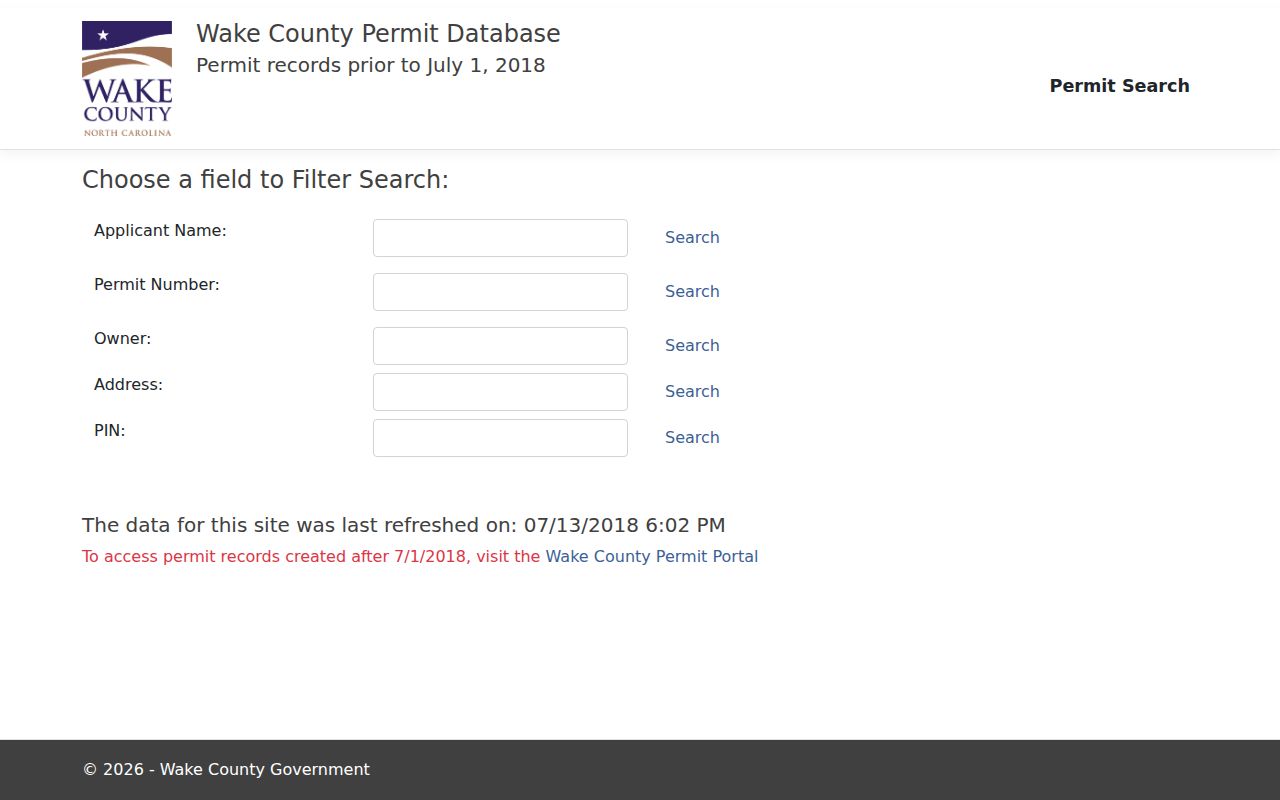
Use an older permit as dated parcel evidence, then corroborate any personal connection with a deed, directory, census, or estate record.
Morrisville Past Residents in Criss-Cross Books
For the human part of an address history, use a criss-cross directory first and a regular directory second. The cataloged Wills-Smith Raleigh Criss-Cross Directory is the verified address-to-occupant lead at Olivia Raney. Search the street and number, transcribe the printed name exactly, then check the normal alphabetical section for initials, spouse notation, occupation, and address abbreviations that appear in that specific volume. A printed person at the address is an occupancy lead, not proof of ownership.
The Olivia Raney catalog record documents Raleigh-area directory holdings with publisher and title variants, including Polk, Hill, Maloney, Wills-Smith, and related cross-reference titles. It also establishes that the holdings are noncontinuous. The screenshot below captures that catalog route, not a scanned Morrisville directory entry.
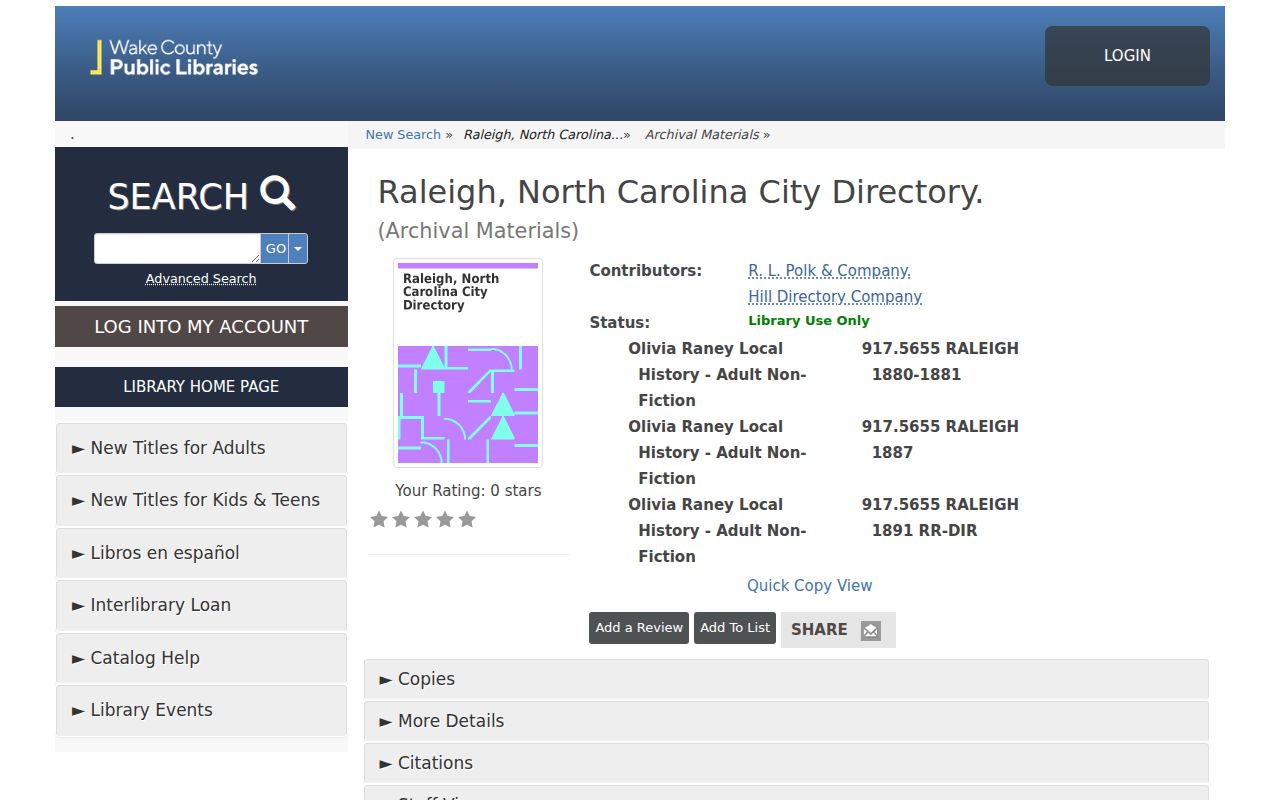
Call the library before visiting to confirm the requested year and whether a Morrisville address may be filed under Raleigh, Wake County, or a neighboring municipality.
Match Morrisville Directory and Census Years
A directory and a census capture different dates. Match each printed address entry to the closest public decennial census, then preserve the publication year and enumeration date separately. The federal census through 1950 is public under the 72-year rule. It can add ages, relationships, and residence context, but it does not erase a directory gap or prove that an address spelling is unchanged.
- Record the directory year, printed address, surname spelling, initials, and page number.
- Check the closest census year for household relationships and residence context.
- Compare the address with the parcel’s legal description, plat, or deed trail when a street label differs.
- Use permits, obituaries, probate, and public election material for later decades instead of implying a public modern household roster.
The verified Raleigh-area shelf and its access details are covered on the Morrisville City Directories page. Keep a missing catalog year separate from a negative name search. That simple distinction prevents many false conclusions about past residents.
Morrisville Previous Residents and Archives
Wake Historical Society is a local-history and research-context lead, not an online name database. Its cataloged papers inventory includes correspondence, projects, tours, photographs, scrapbooks, clippings, maps, and newsletters. Those materials can supply community context around an old address or road. Olivia Raney also provides Wake deed microfilm and fiche, property maps, newspapers, and reference guidance when a digital index stops short.
The Wake Historical Society image below represents that contextual route. For a formal record request or county series, the NC State Archives offers land, court, estate, marriage, tax, naturalization, and military materials through finding aids and an on-site or researcher-request process.
Historical context can explain a road, subdivision, or community name. It does not replace a dated deed, directory entry, census record, or court file.
Morrisville Previous Residents and Map Gaps
Sanborn fire-insurance maps can be a physical-history layer, but the verified Library of Congress examples are Raleigh and Wake context from 1884 to 1914, not dedicated Morrisville plates. The research also found no verified Morrisville-wide renumbering schedule. Treat a road-name mismatch as a prompt to test a route name, subdivision, lot, cross street, plat reference, or parcel identifier. Do not invent a renumbering date.
The North Carolina Digital Collections entry point is another research route, although the research did not locate a dedicated Morrisville city-directory scan there. The image below shows that official collection starting point. It should lead to item-level confirmation, not to a claim that every Morrisville address has been digitized.
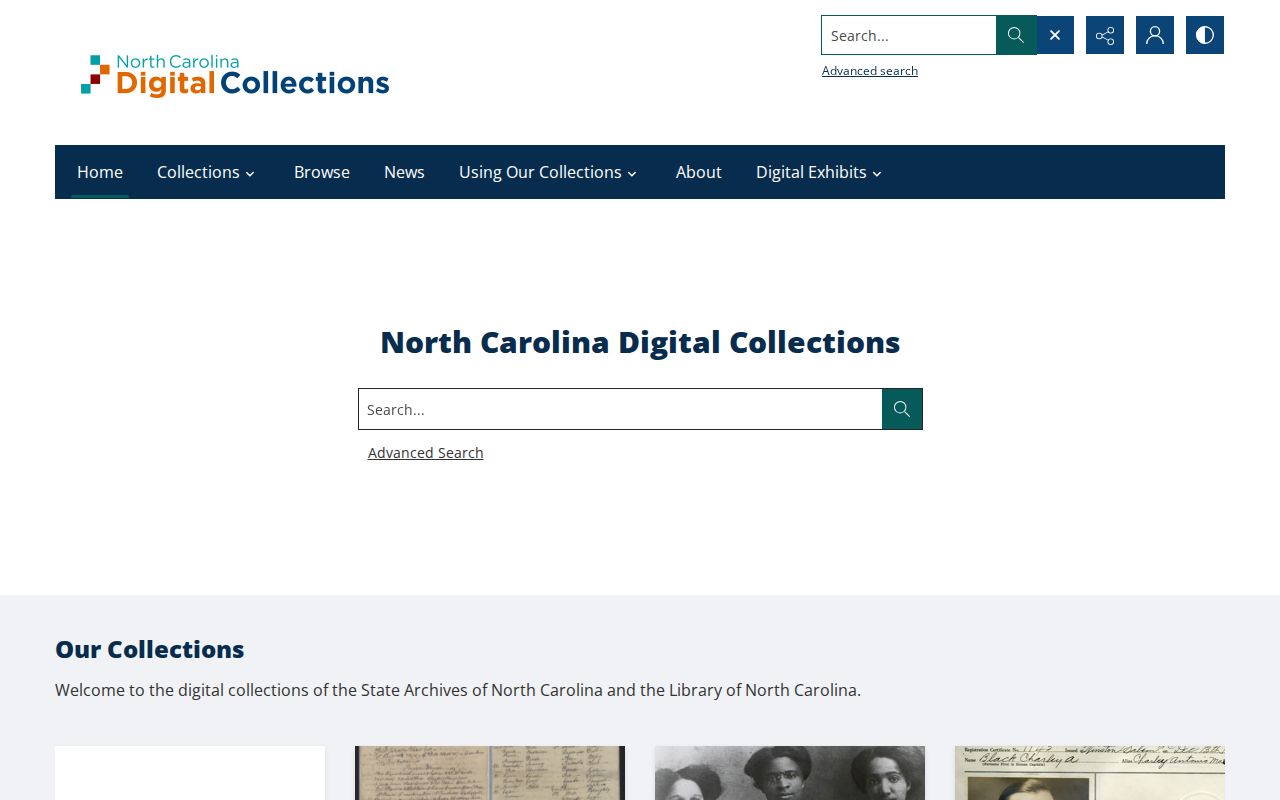
Modern Town maps help crosswalk a current parcel, while older printed labels should be quoted exactly as they appear in the source.
Morrisville Previous Residents: Trail Endpoints
Obituaries and probate can close or branch an address trail. A death notice may name survivors and a former address. An estate file can identify heirs, an administrator, creditors, inventories, petitions, accountings, distributions, and estate property. The Wake Clerk and NC Archives are the official and archival routes when a deeper estate file is needed. A prior owner’s mailing address may be a law office, trust, or relative, so it should not be turned into an assumed residence.
North Carolina Public Records Law gives access to existing public records subject to exceptions and special confidentiality laws. It does not require a government office to create a list of everyone who lived at an address. Ask for a defined record, date span, or case file. Keep a citation and search date with every finding, especially where the proof is a catalog entry rather than the original record.
Lawful use. Morrisville house-history research is for personal, lawful inquiry and family history. Do not use historic address findings to stalk, harass, or expose a living person.